The German healthcare system is at a long-overdue crossroads. Starting in 2026, a cross-sector reimbursement model will become part of daily operations at hospitals and medical care centers (MVZs) for the first time with hybrid case-based flat rates, called “Hybrid Diagnosis-Related Groups” (Hybrid DRG). What initially appears to be a billing technicality will have far-reaching consequences for the IT architecture behind the scenes.
The new reimbursement logic requires patient data, documentation processes, and billing systems to be consistently available across sector boundaries. Hospital architects have been planning in service groups for years. Now, their IT colleagues face a similarly fundamental task.
According to estimates, the reform will gradually bring approximately one million previously inpatient treatments under the Hybrid DRG framework. This sounds like a reimbursement issue. However, it is also a significant IT challenge.
Accurate Hybrid DRG billing requires the hospital information system (HIS), practice management system, surgical documentation, billing system, and electronic patient record (ePA) to function as an integrated system.
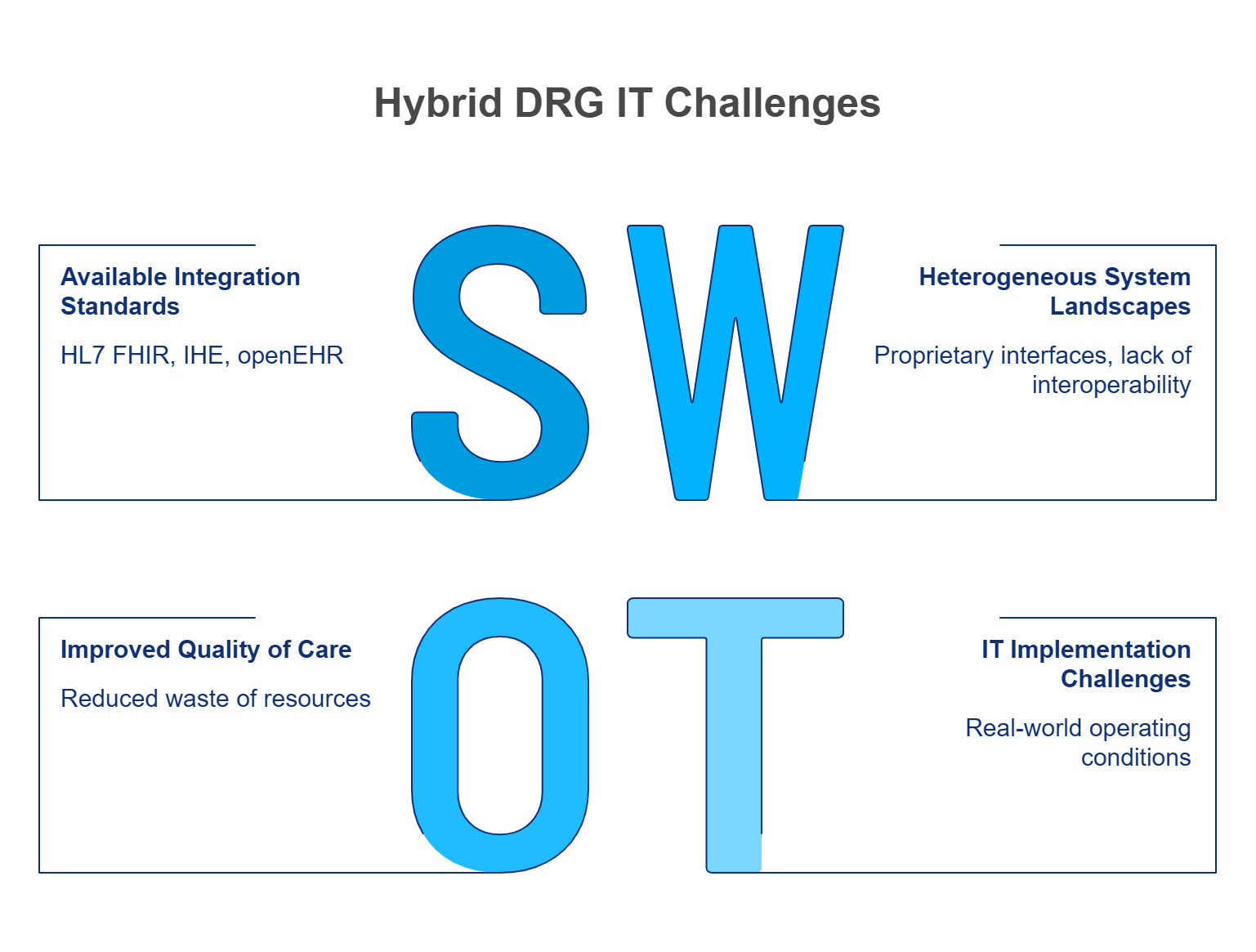
In reality, many facilities’ systems are not integrated. Heterogeneous system landscapes, proprietary interfaces, and a lack of interoperability standards have been tolerated for years because sectoral separation in reimbursement allowed for corresponding gaps in IT. This tolerance ends with Hybrid DRG.
Research findings on interoperability in healthcare demonstrate that a lack of standardization reduces the quality of care and wastes resources. Technical standards for integration are available: HL7 FHIR, IHE profiles, and openEHR offer robust reference architectures. The challenge lies in implementing them under real-world operating conditions.
Those who integrate medical care centers into a growing holding structure are all too familiar with the consequences of a lack of IT consolidation in day-to-day operations. Without a shared database, you end up with parallel patient records, inconsistent billing data, and an almost insurmountable mess of interfaces. Under Hybrid DRG, there is an added revenue risk: Those who cannot accurately document cases across sectors cannot code them correctly, resulting in lost revenue.
Added to this is the regulatory dimension. The ePA has been mandatory for medical facilities since October 2025. According to a survey by the German Hospital Institute (DKI), by the end of 2025, approximately one-quarter of hospitals did not anticipate achieving hospital-wide implementation until the second quarter of 2026. Common reasons include HIS interface problems and insufficient preparation by software vendors.
Closing this gap requires time, a structured approach, and clear prioritization.
Before building a new IT architecture, it is essential to assess the current state honestly. Without this understanding, investments are made on a hunch. A structured approach makes more sense. First, all relevant systems and processes are assessed. Then, they are classified within a maturity model. Finally, a prioritized action plan is created based on the assessment and classification.
In our projects, which have integrated IT-driven medical center structures into holding company landscapes, three areas of action have emerged as particularly impactful:
These steps do not require a complete overhaul. Many facilities can build on existing infrastructure once the gaps are identified. An IT maturity assessment provides this visibility.
If you would like to assess your institution’s current standing and the greatest impact of potential measures, please contact us.
All systems involved in case documentation and billing are affected, including: These include HIS, practice management systems, OR documentation, billing modules, and the ePA. The key factor is their cross-sector connectivity.
Not necessarily. Many facilities can use existing infrastructure if interfaces are consolidated and interoperability standards are implemented consistently. An assessment will identify where action is needed.
A maturity assessment evaluates an institution’s current level of digitization based on defined criteria. It provides a foundation for IT investments and helps prioritize measures effectively.
Hybrid DRG applies to all institutions that perform procedures that replace inpatient care, including medical care centers that offer surgical services. The IT requirements apply across all sectors.
IT projects in the healthcare sector require lead time for assessments, procurement, and implementation. Facilities that start early are significantly better prepared for the Hybrid DRG requirements.
Firstname:
Lastname:
E-Mail Address:
Phone:
Subject:
Your message:
Yes, I consent to my personal data being collected and stored electronically. My data will only be used for the purpose of responding to my inquiry. I have taken note of the privacy policy.
You are currently viewing a placeholder content from OpenStreetMap. To access the actual content, click the button below. Please note that doing so will share data with third-party providers.
You need to load content from hCaptcha to submit the form. Please note that doing so will share data with third-party providers.
You are currently viewing a placeholder content from HubSpot. To access the actual content, click the button below. Please note that doing so will share data with third-party providers.
You are currently viewing a placeholder content from Hubspot Meetings. To access the actual content, click the button below. Please note that doing so will share data with third-party providers.
You are currently viewing a placeholder content from Google Maps. To access the actual content, click the button below. Please note that doing so will share data with third-party providers.