

AI literacy in your team

 24.11.2026

 Academy, Artificial intelligence
Seven out of ten companies now train their employees in the use of artificial intelligence (AI). That’s the finding of a survey of 603 companies with 20 or more employees, published by the German digital industry association Bitkom in September 2026. At the same time, 66 percent rate their workforce’s AI skills as low. Training alone, it seems, isn’t enough.
Meanwhile, the legal situation has become clearer. Article 4 of the EU AI Act, which requires providers and deployers of AI systems to take measures for the AI literacy of their staff, was rewritten in July 2026. Since then, you no longer have to guarantee a specific level of AI literacy for anyone, and the law doesn’t require mandatory training or certificates. What it asks for are measures that fit your employees and the way they use AI. A colleague who drafts texts with a chatbot needs something different from a test manager who adds AI results to test reports, or a regulatory affairs manager who has to classify an AI system.
This article explains what Article 4 requires today, how you can organize training needs with a simple model of competence levels by role, and how you can document your measures in a traceable way without a mandatory certificate. If you already know which roles you want to train: The AI training courses of the sepp.med Academy cover all four roles described in this article.
What Article 4 of the AI Act requires after the Digital Omnibus
What Article 4 of the AI Act requires after the Digital Omnibus
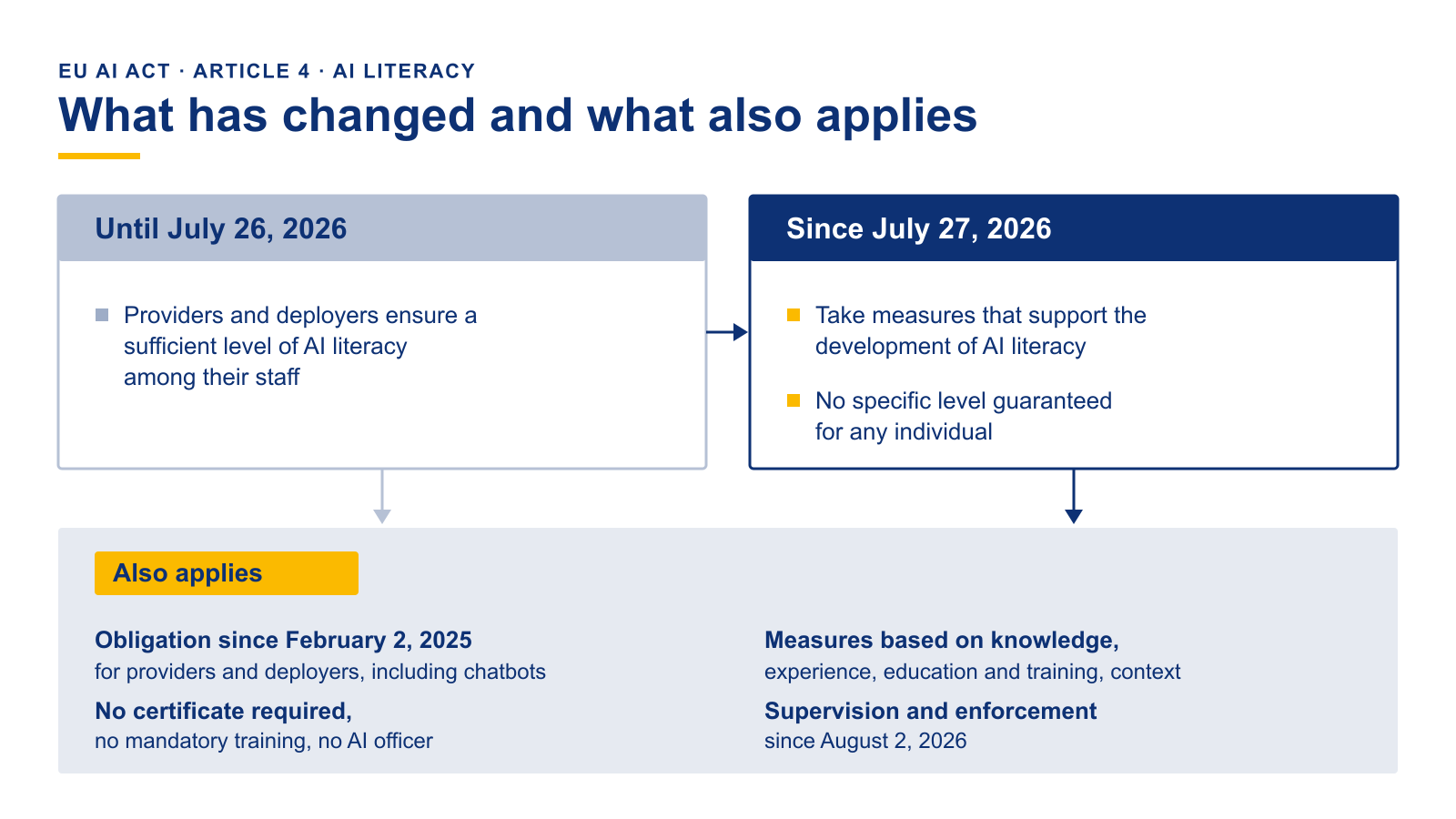
Article 4 has applied to providers and deployers of AI systems since February 2, 2025. A company that only uses AI tools also counts as a deployer. The European Commission was asked whether a company has to comply with Article 4 if its employees use ChatGPT for advertising texts or translations. Its answer is a clear yes: The employees should be informed about the specific risks, for example hallucination. The German Federal Network Agency (Bundesnetzagentur) also lists chatbots among the systems covered.
With the Digital Omnibus on AI, Regulation (EU) 2026/1744, the EU changed the standard. The regulation was published in the Official Journal on July 24, 2026, and entered into force on July 27, 2026. Previously, providers and deployers had to ensure a sufficient level of AI literacy among their staff. Now they “shall take measures to support the development of AI literacy of their staff and other persons dealing with the operation and use of AI systems on their behalf.” A new sentence adds: “This obligation does not require providers or deployers to guarantee any specific level of AI literacy of any individual” (Article 4(1)).
The criteria for the measures have stayed the same: technical knowledge, experience, education and training, the context in which AI is used, and the people on whom it is used. Which measures are appropriate therefore depends on how AI is used.
The authorities are clear about what is not required. The Federal Network Agency lists the following as not mandatory:
- guaranteed levels of competence for individuals
- formalized or standardized training measures
- external certification of the measures
- an AI officer
Who monitors compliance in Germany
According to the European Commission, the rules on supervision and enforcement have applied since August 2, 2026. In Germany, the AI Market Surveillance and Innovation Promotion Act (KI-Marktüberwachungs- und Innovationsförderungs-Gesetz, KI-MIG), in force since July 29, 2026, defines who is responsible. As a rule, this is the Federal Network Agency. For AI directly related to regulated financial activities, it is the Federal Financial Supervisory Authority (BaFin).
The KI-MIG doesn’t provide for fines for violations of Article 4. Its provision on administrative fines in Section 15 lists other articles of the AI Act. That doesn’t mean a lack of AI literacy has no consequences: In the view of the Federal Network Agency, a lack of AI literacy can be considered a breach of the duty of care, especially if it causes damage. If you document your measures, you can show at any time what you have done.
How Article 4 applies to your own company depends on the AI systems you use and on your role as a provider or deployer. For a binding assessment, for example of liability issues, consult your legal department or legal counsel.
Four roles, four levels of competence
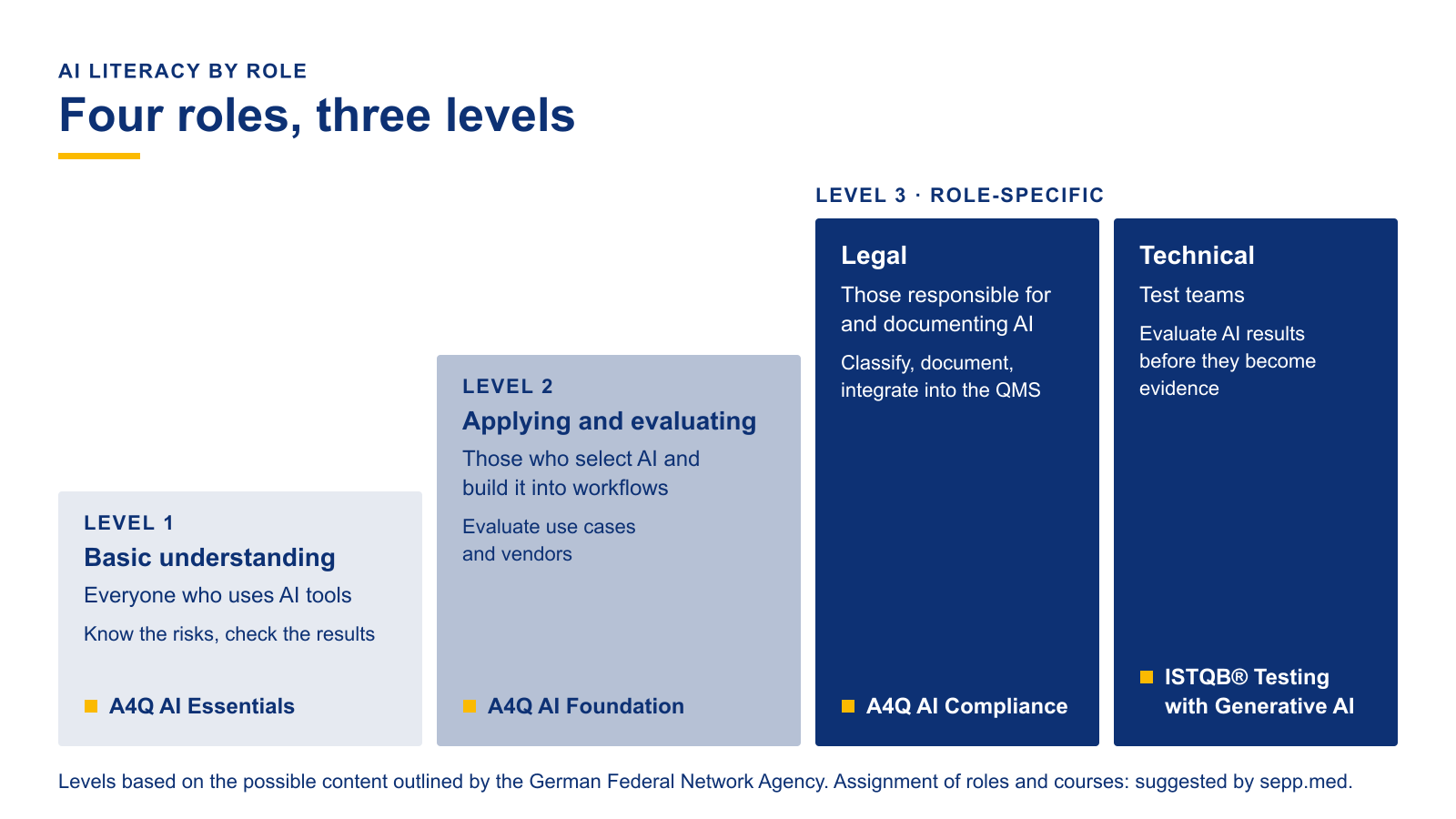
There is no binding model of competence levels for AI literacy. The European Commission explicitly considers different levels of training appropriate. The Federal Network Agency outlines three levels as possible content, which it describes as neither mandatory nor exhaustive: a basic understanding of data and AI within the organization, advanced AI skills, and role-specific training with a focus on areas such as technology, law, or ethics.
For companies in regulated industries, we suggest assigning these levels to four roles. The third level splits into two directions: legal for the people responsible, technical for the test teams.
Everyone who uses AI tools: a shared basic understanding
Anyone who uses a chatbot, a writing assistant, or an AI feature in specialist software needs to know roughly how these systems work and where they make mistakes. This includes hallucinations, which data doesn’t belong in an AI tool, when the use of AI has to be disclosed, and the point at which a person has to check the result. It works best when you combine this with an internal usage policy that sets out approved tools and rules.
For this group, a short and flexible format works best. The e-learning course A4Q AI Essentials requires no technical background and covers the risk categories of the AI Act, transparency, data protection, and human oversight. Participants can complete it at any time on any device, and it creates a shared language across the whole team.
People who select AI and build it into workflows: knowledge to apply and evaluate
Product owners, team leads in business units, IT, and purchasing decide which AI tools the company adopts and what they’re used for. People in this role need to assess use cases and their limits and evaluate vendors for transparency, explainability, and ease of integration. They also need well-structured, documented prompts so that results remain traceable within the team, and a basic understanding of threats such as prompt injection or manipulated training data.
The A4Q AI Foundation course covers these topics using widely used AI systems such as ChatGPT, Claude, and Gemini, along with the basics of AI governance. Next date: January 19–20, 2027, live online (in German).
People who are responsible for and document AI: compliance knowledge
Quality management, regulatory affairs, compliance, and data protection need to classify AI systems according to the risk-based approach of the AI Act and derive the resulting obligations. For high-risk AI under Annex III, these obligations apply from December 2, 2027. For high-risk AI under Annex I, such as AI in medical devices, they apply from August 2, 2028. Until then, these roles need the knowledge to prepare technical documentation, risk management, and fundamental rights impact assessments and to integrate them into the existing quality management system (QMS).
The A4Q AI Compliance course is aimed at professionals who are responsible for, document, and audit AI systems in a regulated environment. It covers the high-risk obligations, technical documentation under Annex IV, and how to integrate AI governance into existing management systems. Next date: January 26–27, 2027, live online (in German).
Test teams: AI as a tool in software testing
Testers use generative AI for test case ideas, test data, or analyzing specifications. Their results flow into test reports and from there into release decisions. Test teams therefore need to be able to evaluate AI results critically before they become part of the evidence. This includes typical error patterns such as hallucinations and bias, protecting confidential data, and integrating the tools into existing test processes. Our article “Three AI tasks in software testing that are often mixed up” shows the different tasks AI can take on in testing.
In the ISTQB® Testing with Generative AI course, around 70 percent of the time is spent working hands-on with AI tools and realistic testing tasks. Participants who already hold the ISTQB® Certified Tester Foundation Level certificate can take the exam afterward. Next date: December 14–15, 2026, live online (in German).
We also offer A4Q AI Foundation, A4Q AI Compliance, and Testing with Generative AI as in-house training, tailored to the needs of your team. Talk to our Academy about it.
How to demonstrate AI literacy without a mandatory certificate
The Federal Network Agency recommends three building blocks: identify needs, design measures, and then document, evaluate, and refresh. The documentation should cover the type of measures, their content and duration, and the participants. In practice, a competence matrix with one row per role works well for this:
- Role – e.g., business user, product owner, regulatory affairs, test manager
- AI systems used – which tools and features the role uses, taken from your AI inventory
- Competence level – based on the level model above
- Measure – training, briefing, usage policy, or self-study course
- Evidence – certificate of attendance, certificate, or internal record with date, content, and scope
- Refresher – when the role is due again, e.g., when new tools are introduced or use changes
In regulated industries, you don’t have to build anything new for this. Your quality management system already keeps competence requirements and training records for each role, and AI literacy is simply one more requirement. Our article “AI Act meets MDR” explains why a second management system alongside the existing one is the wrong approach.
A certificate isn’t required for Article 4. For roles with responsibility, it can still make sense, because it confirms the content and scope of a training course from the outside. A4Q certificates are valid for two years, which builds the refresher into the plan.
Effectiveness remains important. When 70 percent of companies train their employees and two thirds still rate their employees’ skills as low, it shows that the number of people trained says little about whether the measures work. Check at regular intervals whether people in each role apply what they've learned in their daily work, for example in reviews of AI-assisted work results.
Conclusion: Plan competence by role
Article 4 doesn’t require mandatory training for everyone, and it doesn’t require a certificate. It requires measures that fit the people and the use of AI in your company, and you should be able to show what you’ve done. With four roles, three levels, and a competence matrix, you have a plan that fits into your existing quality management and grows with new tools.
AI training at the sepp.med Academy
The sepp.med Academy offers a suitable training course for each of the four roles, as an open seminar or as in-house training. Our trainers come from projects in regulated industries and know the questions that arise when people work with AI every day. Get in touch if you’re planning a learning path for your team.


FAQ
Article 4 requires measures for everyone who works with AI systems on your behalf. It doesn’t prescribe a specific form of training. The type and scope depend on the role and on how AI is used.
No. According to the European Commission, an internal record of the measures is sufficient, and no specific governance structure is required.
Yes. Any company that uses AI tools professionally is a deployer. Employees should at least know the typical risks, such as hallucinations.
The German KI-MIG doesn’t provide for fines for Article 4. According to the Federal Network Agency, however, a lack of AI literacy can be considered a breach of the duty of care.
Sources
- Bitkom e. V. (2026, September 14). Erstmals nutzt die Mehrheit der Unternehmen KI [For the first time, the majority of companies use AI] [Press release]. https://www.bitkom.org/Presse/Presseinformation/Erstmals-nutzt-Mehrheit-Unternehmen-KI
- Bundesnetzagentur. (n.d.). KI-Kompetenz [AI literacy]. Retrieved November 24, 2026, from https://www.bundesnetzagentur.de/DE/Fachthemen/Digitales/KI/7_Kompetenz/start.html
- European Commission. (2026, October 20). AI literacy – Questions & answers. https://digital-strategy.ec.europa.eu/en/faqs/ai-literacy-questions-answers
- Gesetz zur Marktüberwachung und Innovationsförderung von künstlicher Intelligenz (KI-Marktüberwachungs-und-Innovationsförderungs-Gesetz – KI-MIG) [AI Market Surveillance and Innovation Promotion Act] of July 22, 2026, BGBl. 2026 I No. 223. https://www.gesetze-im-internet.de/ki-mig/BJNR0DF0B0026.html
- Regulation (EU) 2026/1744 of the European Parliament and of the Council of 8 July 2026 amending Regulations (EU) 2024/1689, (EU) 2018/1139 and (EU) 2023/1230 as regards the simplification of the implementation of harmonised rules on artificial intelligence (Digital Omnibus on AI). OJ L, 2026/1744, 24.7.2026. https://eur-lex.europa.eu/eli/reg/2026/1744/oj?locale=en