Reimbursement pressure in radiology

 28.10.2026

 Consulting, Future Healthcare, Healthcare and MedTech Consulting, Industries
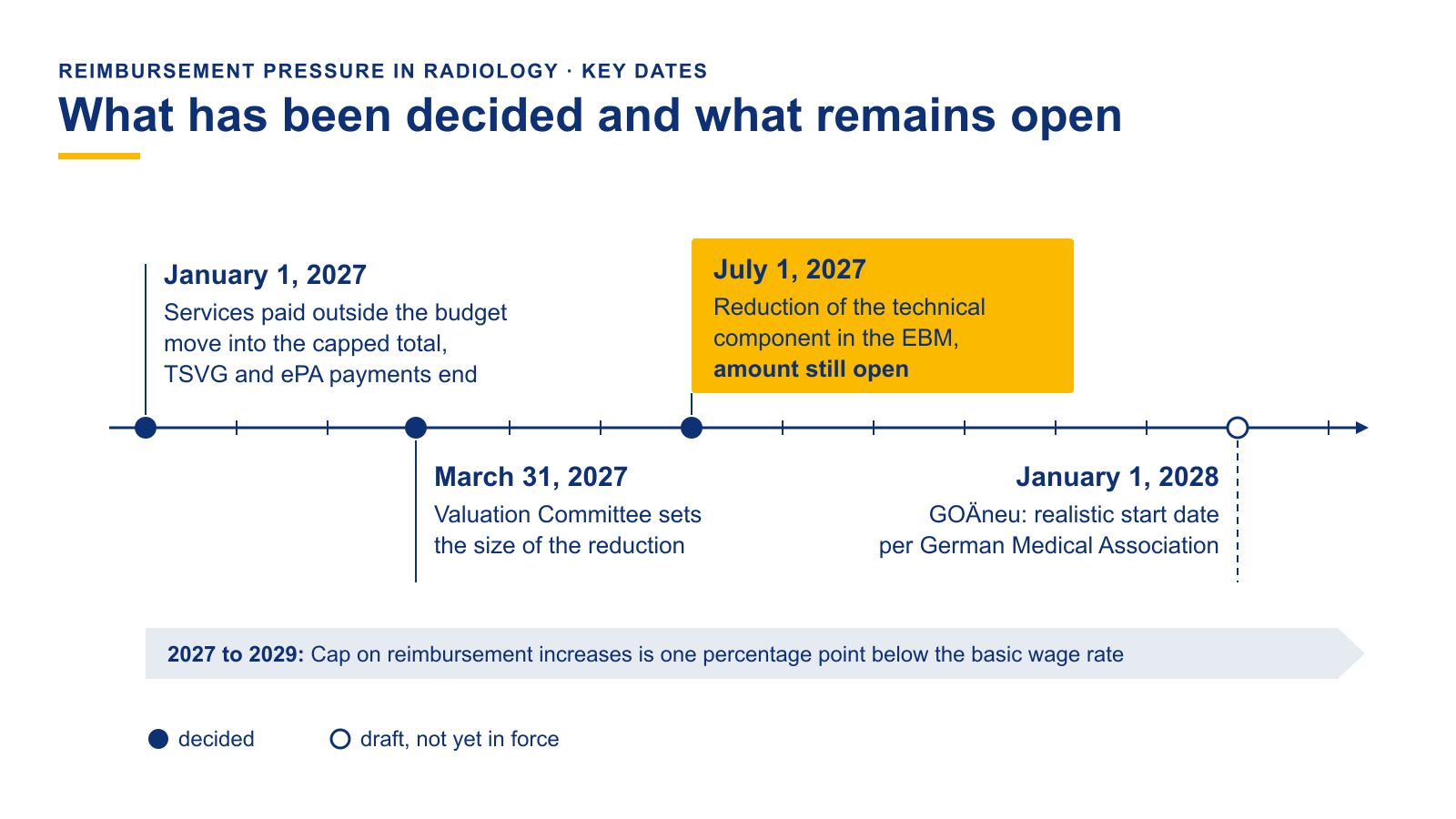
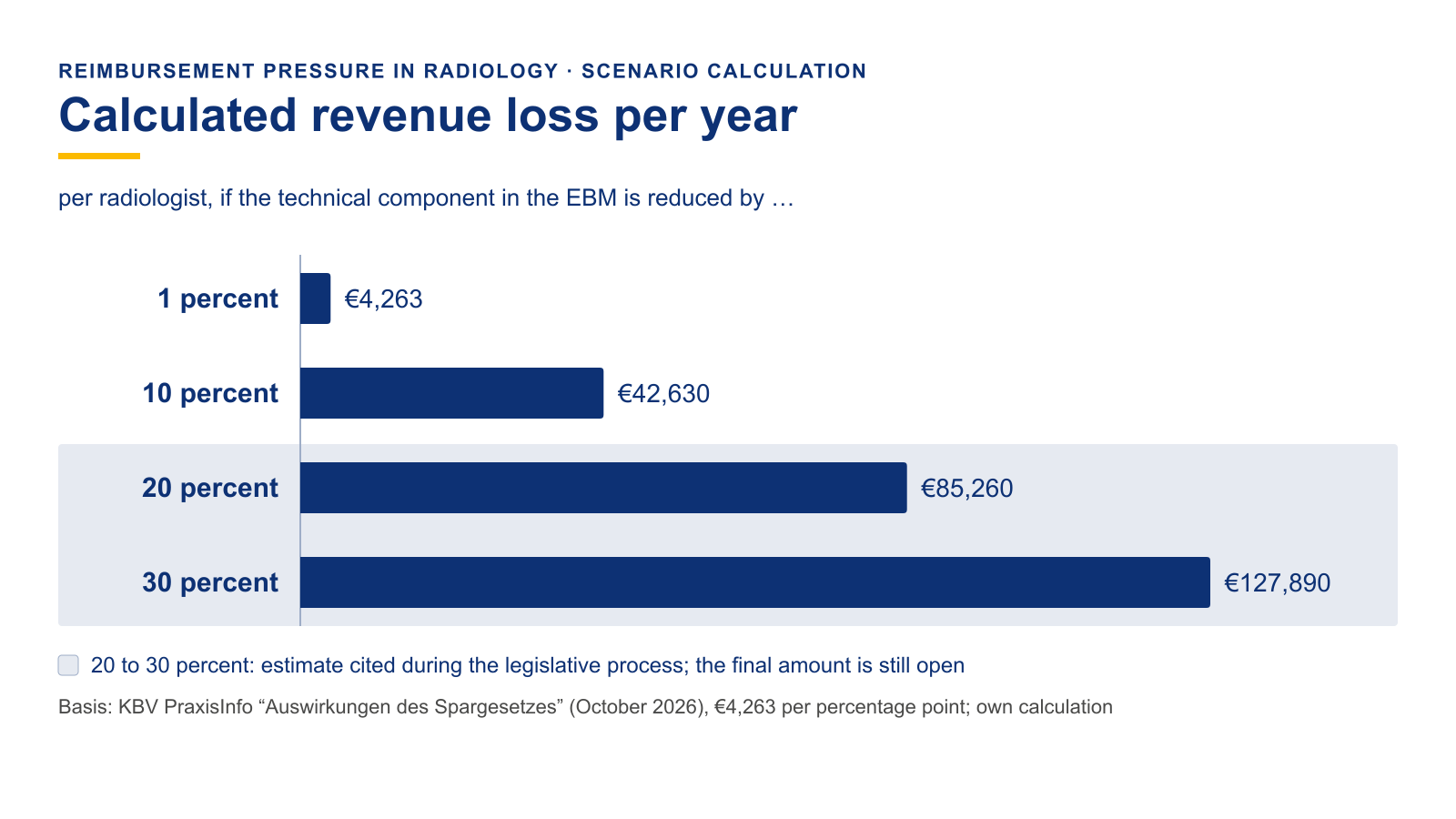
On March 31, 2027, Germany’s Valuation Committee (Bewertungsausschuss) will decide how much the technical component for radiology in the Uniform Value Scale (Einheitlicher Bewertungsmaßstab, EBM) will be reduced. The reduction applies from July 1, 2027. The National Association of Statutory Health Insurance Physicians (Kassenärztliche Bundesvereinigung, KBV) calculates that each percentage point means €4,263 less revenue per radiologist per year.
The Valuation Committee decides on the amount. Your own costs are yours to manage, and IT is a cost item where mandatory spending and avoidable inefficiencies can overlap. This article is for owners, commercial managers, and practice managers of radiology practices and medical care centers (Medizinische Versorgungszentren, MVZ). It shows what has been decided for 2027 and which three levers you can review over the coming months. They correspond to the three focus areas of our strategic IT and AI consulting for radiology practices: cutting operating costs, using AI cost-effectively, and safeguarding practice transfers.
What has been decided for radiology practices in 2027 and what remains open
What has been decided for radiology practices in 2027 and what remains open
The German Bundestag passed the Statutory Health Insurance Contribution Rate Stabilization Act (GKV-Beitragssatzstabilisierungsgesetz, GKV-BStabG) on July 10, 2026. It took effect on July 30, 2026, and many of its provisions apply from January 1, 2027, at the latest. Four points matter for radiology practices:
- Cap on reimbursement increases: Increases may not exceed the basic wage rate (Grundlohnrate), and from 2027 to 2029 the cap is set one percentage point below it. The orientation value (the euro value of one EBM point) rises by 2.2 percent to 13.0207 cents in 2027.
- Less payment outside the budget from January 1, 2027: With few exceptions, services previously paid outside the capped budget move into the morbidity-based total remuneration (morbiditätsbedingte Gesamtvergütung) and become subject to volume limits. Separate payment for cases under the Appointment Service and Care Act (Terminservice- und Versorgungsgesetz, TSVG) ends, as does payment for filling the electronic patient record (elektronische Patientenakte, ePA).
- Technical component from July 1, 2027: The reduction applies only to radiology, nuclear medicine, and radiation therapy. How large it will be has not yet been decided. According to Deutsches Ärzteblatt (as of July 6, 2026), estimates of 20 to 30 percent were mentioned during the legislative process.
- GOÄneu still a draft: The new German Medical Fee Schedule (Gebührenordnung für Ärzte, GOÄ), which governs private billing, is not yet law. The German Medical Association (Bundesärztekammer) considers January 1, 2028, a realistic date for it to take effect. An analysis by the IGES Institute, commissioned by the German Radiological Society (Deutsche Röntgengesellschaft, DRG) and the Professional Association of German Radiologists (Berufsverband der Deutschen Radiologie, BDR), expects revenue reductions of around 36 percent for outpatient radiology. This is neither an official impact assessment nor an adopted figure.
For your planning, this means: The next twelve months bring concrete changes, some of which have already been decided. The GOÄneu is a risk from 2028 onward that you should include as a scenario but do not need to treat as a forecast.
Why IT still belongs on the list
First, a caveat: IT is not the cause of the reimbursement pressure. According to the cost structure statistics of the Federal Statistical Office (Statistisches Bundesamt, Destatis) for reporting year 2024, a practice for radiology, nuclear medicine, and radiation therapy had average expenses of €2.388 million against revenues of €3.675 million. That is around 65 percent. The published core table only shows total expenses and has no separate item for IT. The figures also exclude MVZ and multidisciplinary group practices.
The KBV describes the situation like this: Costs for staff, rent, medical equipment, and digitalization keep rising while reimbursement is capped. In this environment, IT has three characteristics that make it a candidate for review:
- Mandatory spending: Practices that operate large medical equipment such as CT or MRI scanners must also meet Annex 4 of the KBV IT Security Guideline (Anlage 4 der KBV-IT-Sicherheitsrichtlinie). Among other things, it requires restricted access to configuration and maintenance interfaces and logging of security-relevant events. The devices should also have their own segment in the practice network.
- Growing requirements: Germany’s law implementing the NIS2 Directive (the EU directive on network and information security) took effect on December 6, 2025. Practices and MVZ with at least 50 employees may be affected. According to the KBV, the first step is an NIS2 applicability check.
- No benchmarks: Without comparative figures, it is hard to judge whether your own IT costs are appropriate. The first step is therefore a dedicated IT cost center covering hardware, licenses, maintenance, service providers, telematics infrastructure (TI), and security.
A radiology project shows how a mandatory topic can be tackled in a structured way. The Radiologisch-Nuklearmedizinisches Zentrum (RNZ) in Nuremberg had its NIS2 implementation status assessed in an interview-based gap analysis, with the goal of not disrupting ongoing medical operations. Twelve topic areas were captured in a workshop and classified using a maturity model. RNZ’s Commercial and Technical Director says: “The workshop was well-prepared and clearly structured.” The result was a management report outlining strengths and areas for action.
Lever 1: Cut operating costs without compromising security
Typical starting points for lower operating costs are duplicated work, parallel systems, and processes that can be automated. Three measures can be tackled within a few weeks:
- Contract and license inventory: List your radiology information system (RIS), picture archiving and communication system (PACS), teleradiology, maintenance, and remote maintenance, and record contract terms and notice periods. After acquisitions and site mergers, parallel systems and contracts may be running side by side.
- Eliminate manual handoffs: Every manual transfer between scheduling, RIS, PACS, billing, and the ePA takes up the time of radiologic technologists (Medizinische Technologinnen und Technologen für Radiologie, MTR) and medical assistants. From 2027, payment for filling the ePA ends, but the obligation remains. That makes automatic transfer from the RIS a cost issue.
- Backup restore test: A backup whose restore has never been tested offers no security in an emergency. With average revenues of €3.675 million and around 250 working days, one practice day corresponds to roughly €14,700 in revenue (a rough estimate that does not account for catch-up effects).
Strategically, consolidating the RIS/PACS platform and segmenting the network for large medical equipment belong on the list. Both require planning, but they address topics that Annex 4 and the NIS2 obligations raise anyway.
Lever 2: Use AI cost-effectively
AI is a constant topic in radiology. Its economic benefit for individual practices has so far been quantified in only a few studies. A systematic review by Molwitz and colleagues (Radiology: Artificial Intelligence, 2026) found that only about one percent of 1,879 studies explicitly quantified economic effects. AI was cost-effective mainly for high-volume, resource-intensive tasks, provided its accuracy matched human performance. Savings are most likely when AI replaces scarce staff resources or avoids follow-up examinations. Molwitz sums it up: There is no universal AI dividend; the economic value depends heavily on where and how the technology is used. There is another point practices should keep in mind: According to Deutsches Ärzteblatt, the rationale for reducing the technical component cites shorter examination times through AI-assisted diagnostics as an example. This suggests that efficiency gains do not automatically stay with the practice. So base your calculations on the benefit that arises under your own conditions. This leads to three questions for every AI use case:- Bottleneck: Which specific bottleneck in your practice gets smaller (reporting time, waiting time, rework)?
- Total cost: What do licensing, integration with RIS and PACS, validation, and ongoing operation cost?
- Measurability: How will you measure after three months whether the investment pays off?
Lever 3: Safeguard practice transfers and succession
Anyone buying, selling, or integrating a practice into a group is also negotiating about IT. The state of the IT, the contracts, and the investment needs help determine the risks and follow-up costs on both sides. Open licensing issues, long-term contracts, and an undocumented security status can be reflected in the purchase price or in warranties. This is a professional assessment, not the result of a market study.
Practices that keep their IT documentation ready make any review easier: contracts, licenses, archives, security records, and an assessment of their maturity level. One example is the integration of many individual practices into an MVZ holding company that we supported. There, the practices were classified in a maturity system through an IT and security assessment and received individual plans (LifeLink success story). Our article IT due diligence: The key to successful practice integration describes the buyer’s perspective.
How to proceed until March 31, 2027
Four steps are enough for a solid start:
- Calculate scenarios: Model your own EBM revenue with a reduction of the technical component by 1, 10, and 20 to 30 percent (KBV factor: €4,263 per radiologist and percentage point), plus the effects of losing payment outside the budget. This works out to €42,630 per radiologist per year at 10 percent, €85,260 at 20 percent, and €127,890 at 30 percent.
- Set up an IT cost center: Record all IT costs in one place; otherwise you cannot demonstrate any savings.
- Bundle mandatory topics: Plan Annex 4, NIS2 applicability, and the ePA transfer as one project, starting with the restore test and the emergency plan.
- Review one AI use case: Apply the three questions to the most promising use case.
A check-up like this works best when it follows a clear structure: Take stock of contracts, licenses, backups, and security status, then derive a prioritized list of measures that separates quick wins from strategic investments.
Conclusion: Costs are the part you can shape now
Reimbursement decisions are made in Berlin and by the Valuation Committee. You shape your practice IT yourself, with a clear inventory, priorities based on benefit, cost, and urgency, and a pilot project whose success you can measure. There is still time for a first pass before spring 2027.
Where does your practice IT stand today, and which measures offer the greatest leverage? Talk to us.
FAQ
The published core table of the official cost structure statistics does not show a separate IT item. Set up your own IT cost center to determine your figure.
That depends on its size. Practices and MVZ with at least 50 employees may be affected. According to the KBV, the first step is an NIS2 applicability check.
No. It is a draft; according to the German Medical Association, January 1, 2028, is a realistic date for it to take effect.
That depends on the use case. Check the bottleneck, total cost, and measurability before you invest.
An inventory: Record contracts, licenses, backups, and security status, and prioritize them by benefit, cost, and urgency.
Sources
- Bundesärztekammer. (2026). GOÄ-Novellierung [Amendment of the German Medical Fee Schedule].
- Bundesgesundheitsministerium. (2026, July 10). Bundestag beschließt GKV-Beitragssatzstabilisierungsgesetz [Bundestag passes Statutory Health Insurance Contribution Rate Stabilization Act] [Press release].
- Deutsche Röntgengesellschaft. (2026, June 12). GOÄneu: Aktueller Sachstand und Veröffentlichung der IGES-Auswirkungsanalyse [GOÄneu: Current status and publication of the IGES impact analysis].
- Deutsches Ärzteblatt. (2026, July 6). Wegfall von Hygienezuschlag sowie Überprüfung von EBM-Leistungen vorgesehen [Hygiene surcharge to be dropped and EBM services to be reviewed].
- Kassenärztliche Bundesvereinigung. (2025, December 18). Neue Vorgaben für Cybersicherheit in Deutschland [New cybersecurity requirements in Germany].
- Kassenärztliche Bundesvereinigung. (2026, September 23). Einigung bei den Finanzierungsverhandlungen: Orientierungswert steigt um 2,2 Prozent [Agreement in funding negotiations: Orientation value rises by 2.2 percent].
- Kassenärztliche Bundesvereinigung. (2026, October). Auswirkungen des Spargesetzes [Effects of the savings law] [PraxisInfo].
- Kassenärztliche Bundesvereinigung. (2026, March 5). Medizinische Geräte sicher ins Praxis-Netzwerk einbinden [Integrating medical devices securely into the practice network].
- Kassenärztliche Bundesvereinigung. (n.d.). Anlage 4: Zusätzliche Anforderungen für Medizinische Großgeräte [Annex 4: Additional requirements for large medical equipment].
- Molwitz, I., et al. (2026). Economic Value of AI in Radiology: A Systematic Review. Radiology: Artificial Intelligence, 8(1), e250090 (published online November 19, 2025).
- RSNA. (2026, May 26). Radiologists Urge Economic Realism in AI Adoption [Press release].
- Statistisches Bundesamt. (2026). Mittelwerte und Mediane der Einnahmen, Aufwendungen und Reinerträge je Praxis [Means and medians of revenues, expenses, and net income per practice] (reporting year 2024).